Some time in October 2004, on a cool day in Sydney I had an art epiphany. I was doing the rounds of the galleries on a visit from Darwin and I had been looking forward to visiting the AGNSW to see Crossing Country: the alchemy of western Arnhem Land art curated by Hetti Perkins. The exhibition had been getting rave reviews and the few images I had seen, like the scary Yawkyawk by Jimmy Njiminjuma on the cover of the catalogue, were compelling.
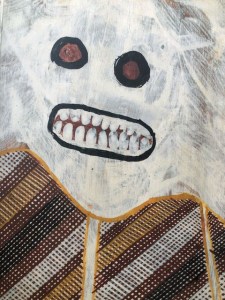
To say the exhibition was a revelation would be an understatement. It opened my eyes to the rich lineage of Kuninjku artists from Western Arnhem Land in a way that has had a lasting impact – from the small bark paintings by unknown artists from the early part of the 20th century right through to the monumental masterpieces of John Mawurndjul and James Iyuna painted towards the end of the century and the early 2000s. The exhibition was filled with revelations – the early works of Paddy Compass featuring dynamic sinuous intertwined spirit figures, to the of the seemingly abstract mardayin paintings of Yrirwala from the 1970s, to austere works by Lofty Bardayal and Wally Mandarrk, to artists with distinct styles such as Crusoe Kuningbal and Jimmy Njiminjuma, whose frightening visions of the YawkYawk, leave a lasting impression.
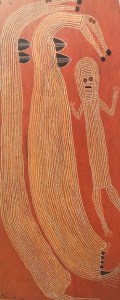
Seeing these works together and in relation to one another felt like being let into a magical and special world of secret knowledge and ancestral power, where one artist built on the legacy of the artists who had come before them and who had innovated and created their own ways of interpreting the sacred stories of their country. It felt like it was a privilege to be viewing these works; like we had been let into something special.
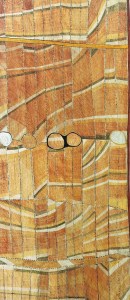
But the biggest revelation was towards the end of the exhibition – the six works by John Mawurndjul. I was blown away by the scale of them, the intricate beauty and complexity of skeins of the finest rarrk cascading across the surface of the barks, forming rhythmic bands and multifaceted designs of great sophistication. What an artist I thought. Brilliant.
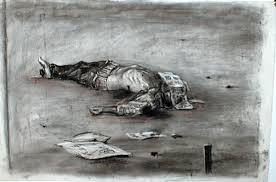
I left the art gallery feeling high, clutching the catalogue, and headed down the hill on a familiar route – through the Botanic gardens, around the corner past the Opera house navigating the throng of tourists, towards the Museum of Contemporary Art. The main drawcard there was South African artist William Kentridge. I had heard of him but was not really familiar with his work. Again, on the same day I was blown away by the work of a brilliant artist who had revealed a distinct world view and his own very particular style. Kentridge developed a practice based on charcoal drawings which he erases one bit at a time and then uses stop-motion animation to bring the drawings to life as sketchy, black and white animations, often accompanied by music.
The exhibition also included photos, prints, collages and sculptures. Kentridge is a metaphysical artist who deals with the big questions of what it is to be human as well as the political realities of life in South Africa and the absurdities of political systems and power structures. However he is never didactic. The works often have a poetic, mysterious and almost absurdist quality. He also inserts himself into works as an everyman figure in his studio, exploring what it is to be an artist in such a world. His work mesmerised and awed me. Here was a contemporary artist of the highest calibre making work that was accessible, beautiful, poignant and about the big issues of our time. Again a revelation and the feeling of what an artist! Brilliant.
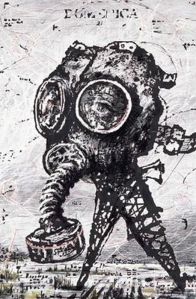
Fast forward 14 years to 2018 and these two great artists were again on show in Sydney and again they exceeded expectations, which was quite a feat. This time John Mawurndjul had a solo show at the MCA and William Kentridge had a self-curated exhibition on the bottom floor of the AGNSW.
Mawurndjul’s show was called ‘I am the old and the new’ and the title summed up his extraordinary achievement as a contemporary Aboriginal artist. Room after room revealed one huge masterwork after the other.
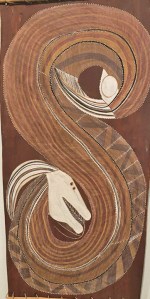
As was obvious from the 2004 exhibition, John Mawurndjul is heir to a long painting tradition, both emulating and learning from a lineage of Kuninjku artists who created magnificent bark paintings over the previous decades. He prides himself on the fact that he is an innovator and a contemporary artist breathing new life into an ancient tradition. In 1988 Mawurndjul began abandoning figurative iconography and over time created an abstracted vision of country and ancestral power. The exhibition showed how Mawurndjul’s art continued to evolve throughout the 1990’s as he perpetually simplified and purified his style to create an increasingly ‘metaphysical form of abstraction with a compelling and esoteric geometry’.
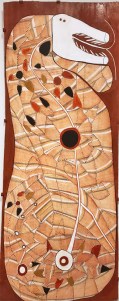
The figure of the Ngaylod or Rainbow Serpent is a recurring theme as are works relating to the Mardayin ceremony at particular places. The exhibition was curated in consultation with the artist and is based around specific sacred sites and areas of importance to the artist. It is a place-based exhibition rather then a chronological or thematic display. In that way it is reflecting the thinking of the artist as the places are the well-spring of his creativity. Some theorists have suggested that this is perhaps not the best curatorial model for the exhibition and a more art historical model would have been better. However, I found it worked and that this more culturally appropriate approach was illuminating and depicted how the artist saw his works in relation to one another. A simply stunning exhibition that showed once and for all that great bark painting can truly be seen as contemporary art.

A few weeks later on another visit to Sydney I headed to the AGNSW to see ‘that which we do not remember’ William Kentridge’s self-curated exhibition, on the bottom floor. Again it was a thrilling exhibition that did not disappoint.
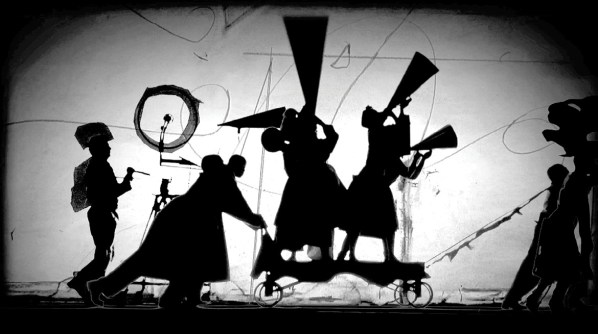
The standout work was one of Kentridge’s most ambitious and celebrated video installations – I am not me, the horse is not mine 2008, which is comprised of eight six-minute films played on a loop. The films were completed as part of the artist’s preparatory work for his production of Dmitry Shostakovich’s satirical opera The Nose and, when presented in a dilapidated room on Cockatoo Island, were the highlight of the 2008 Sydney Biennale. Kentridge uses collage, animation and drawing, with influences from Russian modernism, constructivism and Soviet film from the 1920s and 1930s. The figures seem to be continuously moving around the room towards an inexorable disastrous climax that never happens. It is a hugely impressive and complex work that raises issues to do with the modernist project in art and the absurdity and danger inherent in politics. Other works in the exhibition were slower and calmer with drawn stop-motion animations and numerous drawings and collages throughout the exhibition. There was an anamorphic drawing which was displayed on a circular table and reflected in a metal cylinder that gave the feeling of an animation. Kentridge strives for engagement with his audience as well as the communication of ideas.
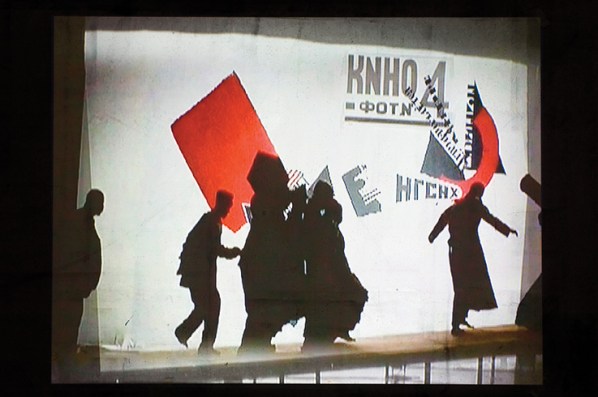
What do these artists have in common that speaks so fervently to me? They are both masters of their craft and great innovators both technically and in relation to how they interpret their subjects. Both artists have also been recognised internationally with multiple exhibitions in different countries. The artists also had a hand in curating their shows from their own perspective and thought deeply about how their work is displayed and perceived. They deal with weighty themes, both sacred and profane, and I was moved emotionally by both artists. Their work communicates directly with the audience. It says something about what it is to be human, albeit from very different cultural perspectives.
So often the experience of big curated shows is depressing or underwhelming, didactic or inconsequential. So many contemporary shows feature banal, ugly, solipsistic or inaccessible works, supposedly subverting some paradigm and solving the world’s problems. These exhibitions were the opposite – uplifting, exciting, revelatory and well curated. They gave me joy and hope.
 Cath Bowdler